In the Spotlight: Daniel Ashman
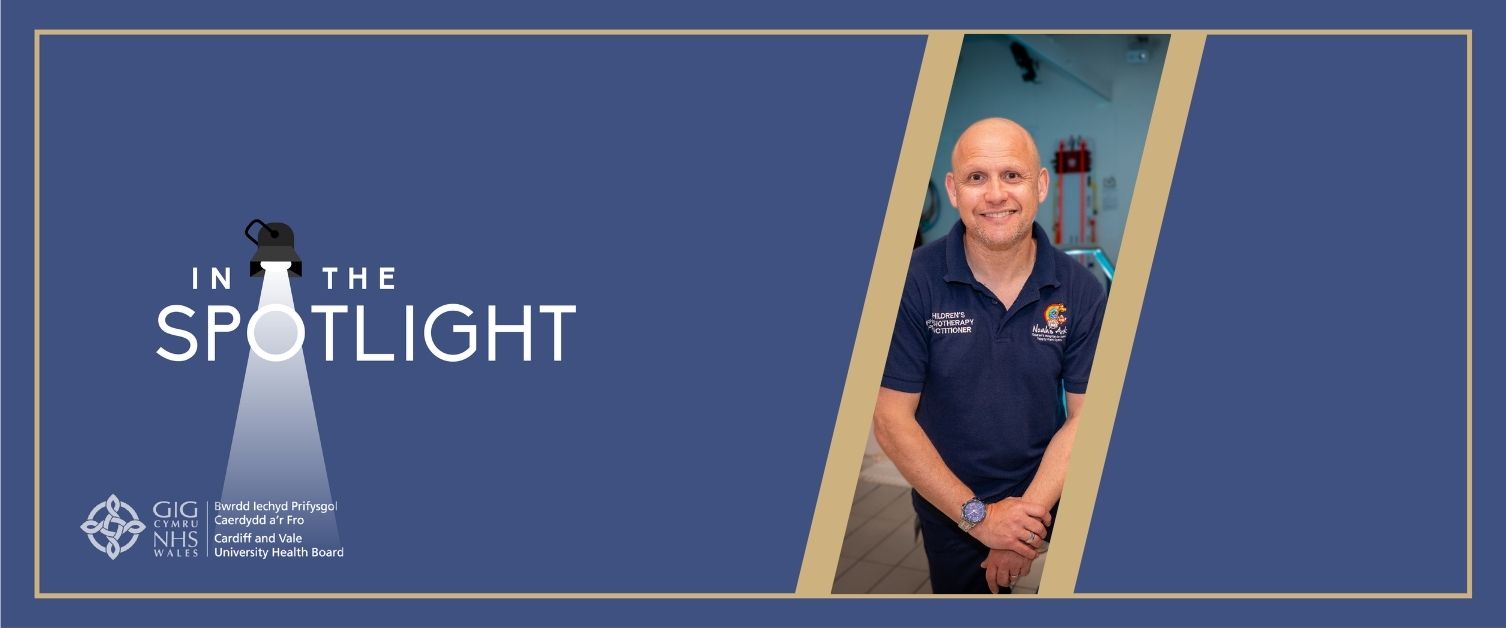
“I always feel happiest when I’ve been working with a patient over a number of weeks and they start seeing the results, and the parents see it. That’s the best feeling then.”
Daniel Ashman is a Physiotherapy Technician who manages the hydrotherapy pool at Noah’s Ark Children’s Hospital for Wales. Based within the Dolphin Physiotherapy Outpatients team, he also supports children and young people to exercise both in the gym and in the hydrotherapy pool.
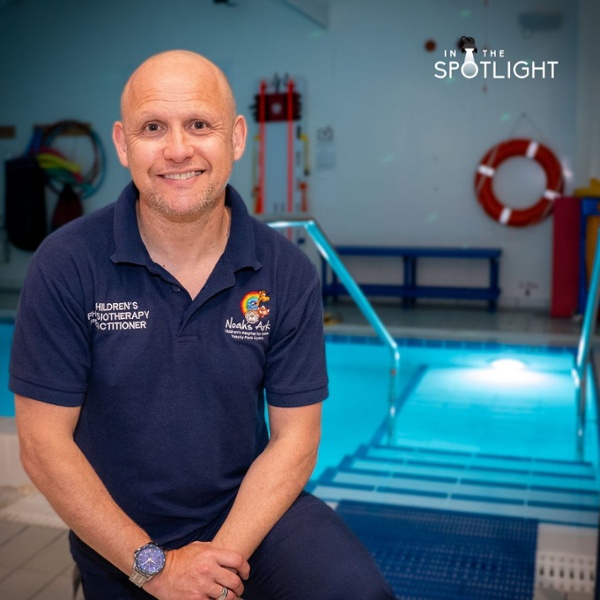 Patients are referred to Dan by their physiotherapist for a five‑week programme, focused on specific goals such as strengthening or flexibility. He said: “Our patients might need a bit more encouragement because they’re not seeing the results they want. Parents may be a little bit worried or anxious as well. There are lots of benefits to hydrotherapy. The longer I’m here, the more I realise.”
Dan has worked for Cardiff and Vale University Health Board for almost 25 years. For 21 of those, he worked in Adult Mental Health services at the former Whitchurch Hospital and Hafan‑y‑Coed. He started as a nursing assistant before quickly moving into Therapies.
“I’ve always been quite into exercise. I was quite sporty as a kid.” (In his younger years, Dan competed for Wales as a middle‑distance runner.) After working in various roles, he became a Physiotherapy Technician and gained his Personal Training qualification. Four years ago, he applied for the role managing the hydrotherapy pool at the Children’s Hospital.
“It’s a great team to work in,” he said. “We are all very, very supportive. Coming to paediatrics, I was aware that it was a big change. I was hoping that people would be patient and they were to be fair. They’ve helped me to build my niche here.”
Throughout the week, Dan works with a range of physiotherapy teams who use the hydrotherapy pool. One morning each week, he runs a clinic for children referred to hydrotherapy from Dolphin MSK outpatients, as well as young people from the adolescent physiotherapy service in Lakeside.
His morning begins by preparing the pool. “I go into the plant room to ensure everything is working, and then do the chemistry tests.” The pool is tested three times a day, twice by Dan and once by engineers including checks on chlorine levels, pH, and both pool and room temperatures.
“Then I prep the hydro pool for the sessions.” To help create a fun child-friendly environment, this includes turning on disco lights, setting up the music system and laying out mats, pool noodles and beach balls. “We usually have four patients back‑to‑back, each 45 minutes. There are always two members of staff, and we normally take it in turns, one writes the case notes and the other does the exercises in the pool with the patients. We always try to make it fun. After the sessions, I’ll close the pool down, clean the floors and put everything away.”
Hydrotherapy is traditionally used for patients who have experienced trauma or undergone surgery and are struggling to weight‑bear. Dan said: “The exercises you want them to do, they are struggling to do on dry land. But once you get them in a pool environment that can change hugely.
“You start working with that person in the pool, and because of the buoyancy that the pool naturally gives you, people are able to weight bear to a higher degree than they ever could on dry land and then you can start strengthening those muscles and waking them up.
"By the end of those five sessions, when they’ve not got that boot on or got that crutch and they’re moving around school easier - that’s definitely the best part of the job!”
The physiotherapy team is also seeing an increasing number of children and young people who struggle to exercise due to psychological barriers.
“The hydrotherapy pool is a really good tool to get these patients to exercise in an environment where they are comfortable. Sometimes it’s even a distraction, they might not realise they are exercising as much as they are. Then it’s about capitalising on that, so they can see what they have achieved. It can give them the boost they need to go on to that next level.”
 People are at the centre of everything we do. Those who work at Cardiff and Vale University Health Board make a difference to people’s lives every single day.
Each month, the In The Spotlight campaign shines a light on the different people who make up Cardiff and Vale University Health Board, from those who support behind the scenes, to those who have passions that led them to work in their role.
As an organisation with over 17,000 colleagues, the campaign will highlight the variety of roles, teams and individuals across the health board. Working in the NHS can be life-changing, both for colleagues and for the patients they help.
Rydym yn croesawu galwadau ffôn yn Gymraeg, Saesneg a Iaith Arwyddion Prydain (BSL) via SignVideo.
We welcome phone calls in Welsh, English and British Sign Language (BSL) via SignVideo.