Cardiff and Vale UHB begins rollout of ambitious new project to improve Supportive Care
11 March 2026
The Supportive Care team at Cardiff and Vale University Health Board have begun the rollout of the Wristband Initiative, a transformative piece of work helping people with life-limiting conditions manage their care.
Currently, 89% of people with an end-of-life condition will use unscheduled care via the Welsh Ambulance Service, and 38% of these will go on to be admitted to hospital.
Patients that understand they have an end-of-life condition generally prefer to be at home when they pass away. Despite 80% of people preferring to pass away in the comfort of their own home, approximately 46% will die in hospital.
The Wristband Initiative aims to help patients with these conditions to be empowered to live their lives as confidently as possible knowing decisions about their care will be communicated in the event they become unwell.
About the Wristband Initiative
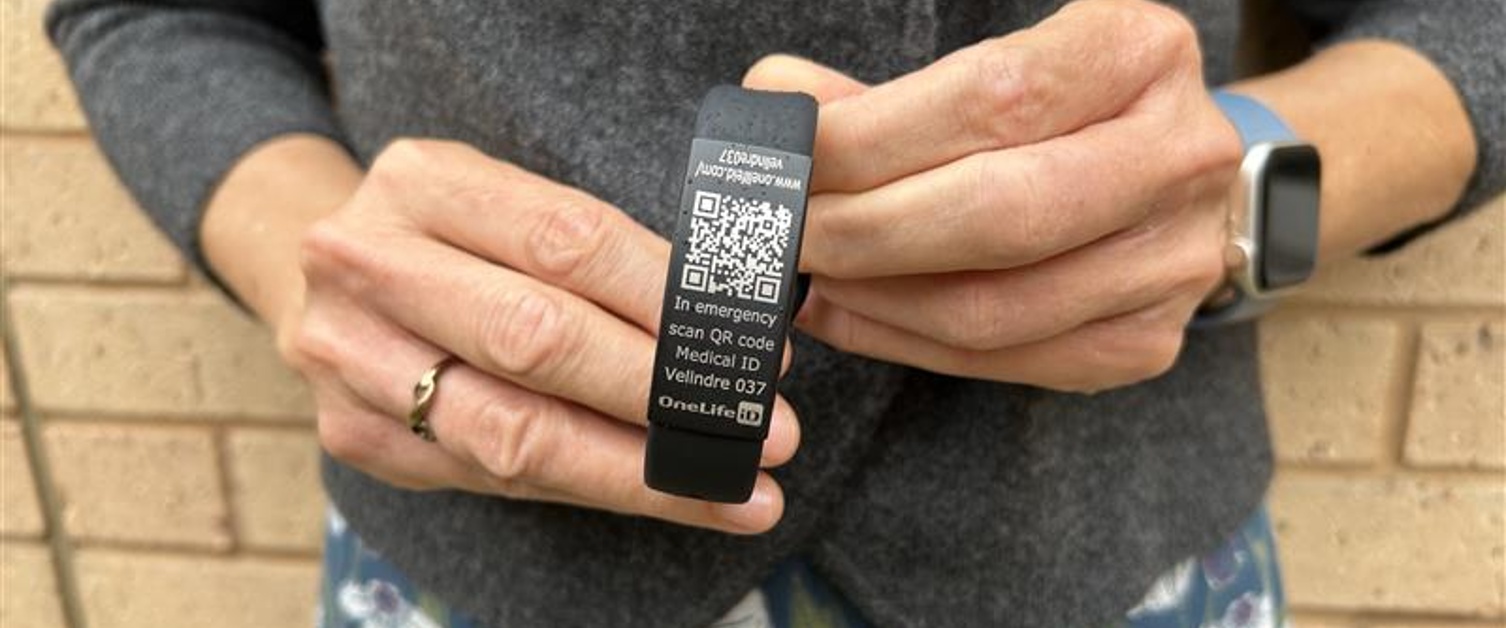
The Wristband Initiative involves suitable patients wearing a wristband with a QR code as a means of sharing important medical information to different healthcare professionals to access when they need it.
The wristband is worn like a watch, with the QR code taking people to a personalised webpage with the patient information uploaded and kept updated by their healthcare team. This information is kept private, and only able to be accessed by also using the PIN code, also found on the wristband.
Information is only shared with the patient’s permission. The type of information likely to be uploaded might include:
- Important current and past medical illnesses and details of treatments they are receiving
- Medications, including any allergies
- Emergency contacts for both loved ones and the patient’s healthcare team
- Information about what to do if the condition progresses
- Information on the patient’s wishes and preferences - for example, some patients do not want to be readmitted to hospital unless there is a clear reason why
- Some patients wish to include a Do Not Attempt Cardiopulmonary Resuscitation (DNACPR) form
Whenever healthcare information about the patient is needed, especially in an emergency, GPs, nurses or paramedics can scan the QR code on the wristband and link to the patient’s individual website.
Hospital care is often the default for deteriorating patients, and the information provided instantly with the wristband can help healthcare colleagues respect their wishes and provide the most appropriate care.
The wristbands had been piloted with an initial ten patients needing supportive care for heart failure, adult congenital heart disease and interstitial lung disease. Following its success, another 200 wristbands have been delivered for an additional roll-out.
Preliminary feedback so far has been outstanding. Patients have noted that they feel more confident to make the most of their remaining time knowing they will be well cared for with their wishes respected.
“I’ve got on a bus because I know they’ll have my information if I became poorly,” said one patient. Another patient had commented that the paramedics they had come into contact with had felt it was very helpful.
Respecting the patient’s wishes is critical to this project’s success. In its first ten patients, it has already led to reduced hospital admissions, better contact with a patient’s care delivery team, and ensured another patient was in their preferred place when their condition deteriorate and needed end of life care.
This project has been brought to life by the QR Code Cymru team made of colleagues from Cardiff and Vale UHB, Velindre and WAST; including Dr Clea Atkinson, Professor Nikki Pease, Dr Elin Harding, Dr Naomi Blowe, Ruth Gisbourne, Mr Ed O'Brian, Jo Sulman, Nina Amps and Molly Baker.
Clea Atkinson, Consultant in Palliative Medicine said: “The Wristband Initiative gives patients the comfort of knowing that, wherever they are, the healthcare professionals looking after them will have instant access to the information that matters most. It empowers people to stay at home and feel more confident.”
The Macmillan End-of-Life Care Social Investment Fund
This initiative has been funded by The Macmillan End-of-Life Care Social Investment Fund which will see Macmillan Cancer Support invest £36m into End-of-Life Care services across the UK with no financial return. The Macmillan EOLC Fund Team provide programme, clinical, financial and data analytics expertise at no cost to the partners.
Macmillan provides up-front funding for services and is repayable if mutually agreed outcomes are met, thereby absorbing the risk. The fund is available now and will see Macmillan invest £36m in End-of-Life-Care services across the UK with no additional financial return.
The Bereavement Team
Conversations about end-of-life can be challenging and emotional. The Health Board has a dedicated Bereavement Support Service available for our inpatients, families and staff. The team offers the opportunity to speak confidentially with someone who understands grief and can offer guidance and support.
They are available to support anyone who is bereaved within the Cardiff and Vale area, and those whose relative or friend dies within one of our hospitals.
The Bereavement Support Service is not a counselling service but can submit referrals for grief specific counselling following review if needed.
The team can be contacted via the following details:
- Telephone: 029 2184 4949
- Mobile: 07812 495281 / 07812 495329
- Email: cav.bereavementservices@wales.nhs.uk
Rydym yn croesawu galwadau ffôn yn Gymraeg, Saesneg a Iaith Arwyddion Prydain (BSL) via SignVideo.
We welcome phone calls in Welsh, English and British Sign Language (BSL) via SignVideo.