Complications of HPN
Line occlusion or blockage
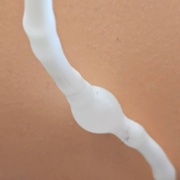 A blockage or occlusion of the line usually occurs as a result of build-up of residue in a line and can be caused by inadequate flushing of the line or something else. To help prevent blockages, the line is flushed with saline after each infusion and with alcohol once a week. If your pump keeps alarming 'downstream occlusion' or you notice some resistance or ballooning when flushing your line or you are unable to completely flush your line, your line may be blocked. You must not use force or try to unblock the line yourself as this may cause the line to rupture. It may be possible to unblock the line with specialist treatment and you should contact the team without delay.
Line break or tear
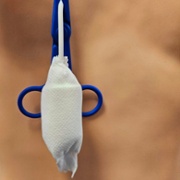 A break, tear or hole usually happens through wear and tear causing weakness in the line. To prevent wear on any part of the line that may weaken it and cause it to split, the clamp should be regularly moved along the thicker section of the line. If the break is inside your body you may notice pain or swelling when you flush or infuse your HPS or you may notice a hole in your line or see feed leaking from the line if the break is outside the body.
It is important that you secure the line to minimize the risk of infection. You should apply a blue clamp between the break/tear and the exit site of the line on your chest and cover the end of the line and around the break/tear with gauze. It is often possible to repair the line and if this is not possible the line will need to be replaced and you should contact the team without delay.
Line Infection
There are several types of line infection, and you should contact the team if you experience any symptoms.
- Tunnel or exit site infection
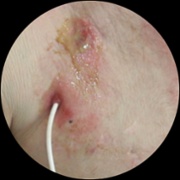
This may start as an irritation or redness of the skin at the exit site of the line, with leakage of serous fluid or pus. If not treated immediately, the infection may travel under the skin and become very red, swollen and painful. The line often has to be removed, and you may need a potential treatment and hospital admission period of 10-14 days.
- Line and bloodstream infection
This is the result of micro-organisms getting into your line. Micro-organisms can be found in the environment and water as well as on the skin. Sometimes if not careful these micro-organisms can find a way into your line and cause infection. Whilst developing an infection may be a result of poor line care and procedures, there are other factors that could contribute to it such as an infection elsewhere in your body that has gone into your line.
To minimise the risk of infection whilst you are caring for your line we ask you follow this advice: turn off fans, close windows and ensure nobody is doing anything around you that could potentially blow or lift up dust containing micro-organisms, such as hoovering or making a bed. Keep pets out of the room and ensure hands are thoroughly dry to prevent water particles dripping onto your sterile field.
If you have a temperature, experience shivering when feeding (rigors), a rapid pulse or breathing and/or feeling very unwell, you potentially have a line infection. You should stop your infusion at once and contact your NST during working hours or if very unwell attend the emergency department in Cardiff or dial 999. You will need to be admitted to hospital for treatment with intravenous antibiotics, and depending on the micro-organism and your clinical condition the line may need to be removed or salvaged. It is likely that you will be an inpatient for 10-18 days depending on which treatment is appropriate. It is essential that you contact the NST as soon as possible at the first possible signs of infection. If you are admitted with a line infection, a nutrition nurse will re-assess your procedures or those of your relative if not independent.
Line migration
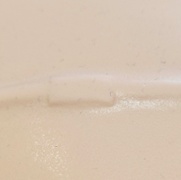 Your tunnel line is held in with a small fibrous cuff called the Dacron cuff. If you have a PICC line then you may have either a statlock or griplock securement device or a securacath to hold it in place.
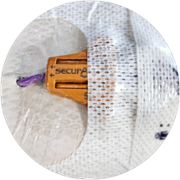 If your line was to become dislodged it could result in your line being in the incorrect position for feeding. If you feel an unusual sensation in your neck or chest on use of your line, hear a whooshing sound in your ear on the same side as your line or your line appears longer or to have moved you should avoid using your line and contact your NST immediately.
Biochemical complications
Your blood tests or biochemistry will be monitored regularly, and your feeds will be adjusted as necessary depending on the results, your clinical condition and fluid balance. The frequency will be less frequent when you are at home. You must inform the NST if you are not receiving all of your prescribed feeds as this may affect your treatment. Swelling of the ankles or legs and being short of breath may mean you are having too much fluid whilst being thirsty, confused, fatigued, passing little or concentrated urine, or having muscle cramps may indicate that you are dehydrated. If you feel unwell or dizzy after your feed, this could be a result of it being infused too quickly or stopped too abruptly. It is important that you report any side-effects you experience related to your infusions to the team.
The feeds sometimes are unable to provide all the nutrients you need and you may require additional infusions such as iron or injections of vitamin D and B12. You may also be prescribed oral vitamin and mineral supplements.
Long term HPN may mean you are at higher risk of osteoporosis or brittle bones. A bone scan (Dexa) will be done every 2-3 years to monitor this. Treatment may include oral supplementation or intravenous therapy.
Hyper/hypoglycaemia
Depending on your underlying risk factors Hyper/hypoglycaemia (low/high blood glucose levels) can occur if on TPN. Due to the glucose levels in your TPN your blood sugars can either go up whilst on your feed or down when not on your feed. If this happens you may experience excessive thirst, frequent urination and/or blurred vision. You should inform your healthcare team if this occurs as there are simple ways of preventing this occuring such as altering the glucose content in your feed, insulin adjustment, feeding for longer or just altering the rate of TPN over the first or last couple of hours. This is called ramping up or down. Our nurses will show you how to do this.
Rydym yn croesawu galwadau ffôn yn Gymraeg, Saesneg a Iaith Arwyddion Prydain (BSL) via SignVideo.
We welcome phone calls in Welsh, English and British Sign Language (BSL) via SignVideo.